Turing Patterns
Activator · Inhibitor · Morphogenesis
How does an organism lay down stripes before it has a striping department?
— Phyllux Media
In 1952 Alan Turing proposed that two chemicals—one short-range activator, one faster-spreading inhibitor—could carve steady spatial patterns. The idea explains stripes, spots, and seashell banding better than top-down blueprints alone. For engineering claims, stay grounded with Research status.
I. Local Rules, Global Shape
The same tension that makes stripes in fish
Picture two substances reacting in tissue. If one activates growth of the other locally, but a second substance diffuses farther and dampens runaway peaks, peaks can stabilize at a predictable spacing.
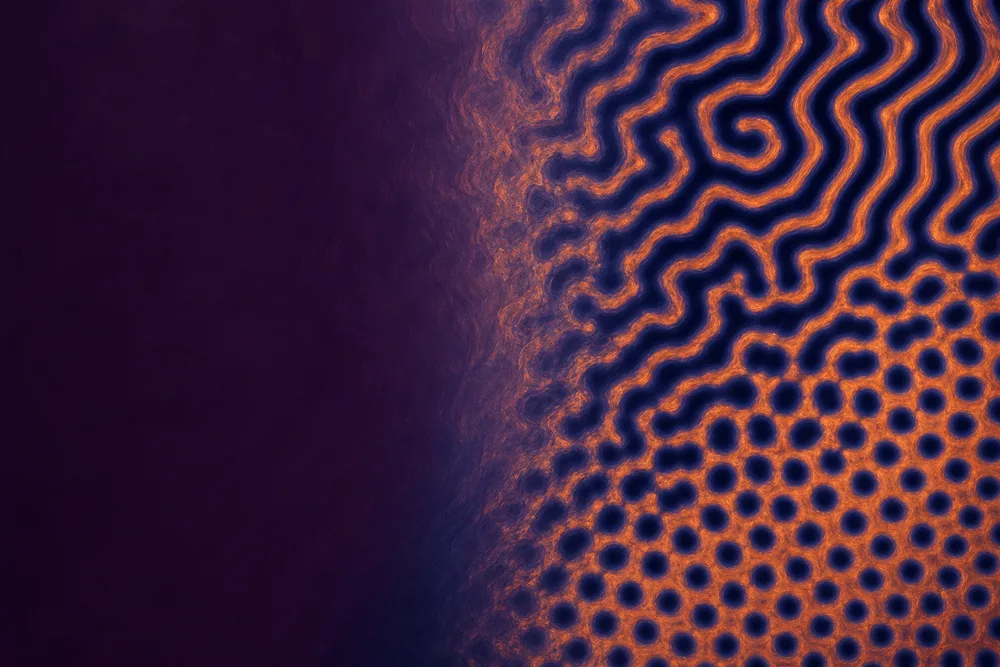
No tiny foreman draws a curve: parameters (rates, diffusion lengths) pick the motif—spots versus stripes versus labyrinthine chaos.
II. Stability and Phase Change
Why a small change flips the motif
Mathematically, pattern formation is often a bifurcation: a homogeneous state loses stability and selects a wavenumber band. That is why biologists see wavelength adjustments when temperature or genetics shift.
“Sensitive dependence” is a feature: the genome tweaks knobs; physics sorts stable layouts.
III. Where It Shows Up
From zebrafish to drylands vegetation
Turing-style models resonate with animal coat patterns, phyllotaxis-adjacent spacing questions, and even vegetation stripes in arid climates where water re-infiltration couples to growth.
Models are not certificates: every organism needs its own measurement story.
IV. Design Lesson
Why Phyllux names Turing beside Sentinel
For designers, the lesson is anti–central-planner hubris: couple a short-range amplifier with a broader stabilizer, let geometry pick the scale. That framing matches biomimetic systems work without promising magic.
When someone sells you “AI that spots anomalies,” ask which field is activating and which is inhibiting—and on what baseline.
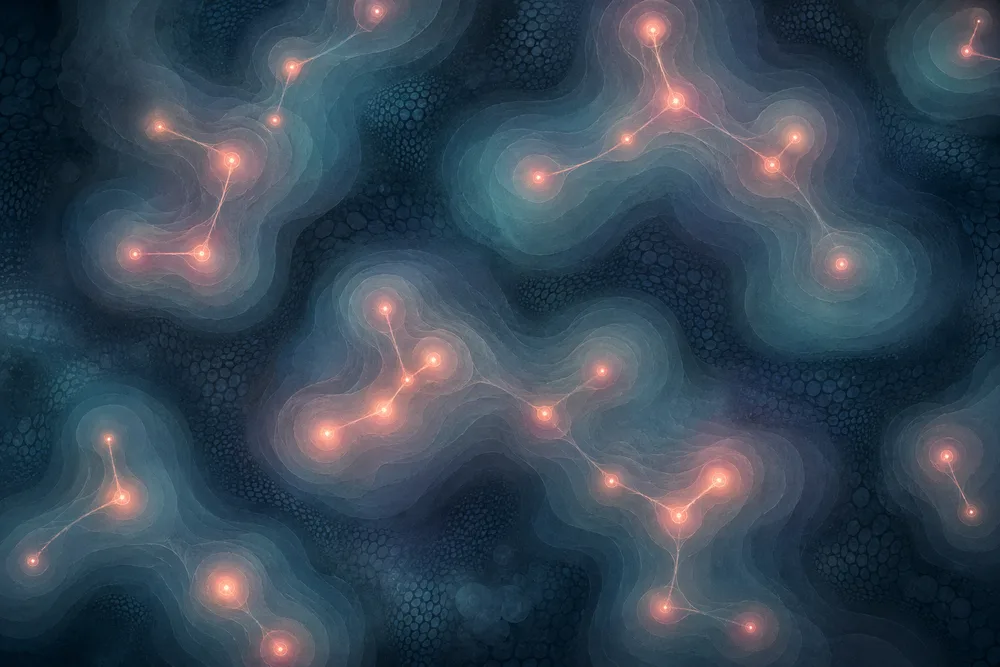

Pattern Without a Tiny Artist
Turing’s paper is old; the wonder is fresh—local chemistry sketching coherent geography.
Spots and stripes: the universe doodling with PDEs.