Black box track: This hub is public; core implementation and repo detail stay partner scoped. Research status (what ships, what is spec): Research status. Technical briefings under NDA: Partners.
Four pillars on one geometric toolkit. WAVE (RF arrays), MESH (neural electrode layout concepts), VAULT (identity and key binding direction), CORE (integration spine). The honest split between design target, simulation, and measured data lives on Research status. Numbers below are ambitions until a public measurement dossier says otherwise.
The Phyllux Accord is our voluntary public covenant: no weaponization, mutual flourishing, and fair benefit sharing around this stack. It also names how we treat 137 and partner use of AI as a tool, not an owner.
Pattern lab (open tools) is the public face of our research CLI and local explorer: structured text windows, null testing, golden angle layout stubs for engineering, and documentation only envelopes. It stays outside vault material and matches the Accord’s lane for careful textual study.
Technology Overview Document
The Technology overview is now staged as markdown for PDF export and embedding. It gives partners and curious readers one coherent introduction to WAVE, MESH, VAULT, and CORE.
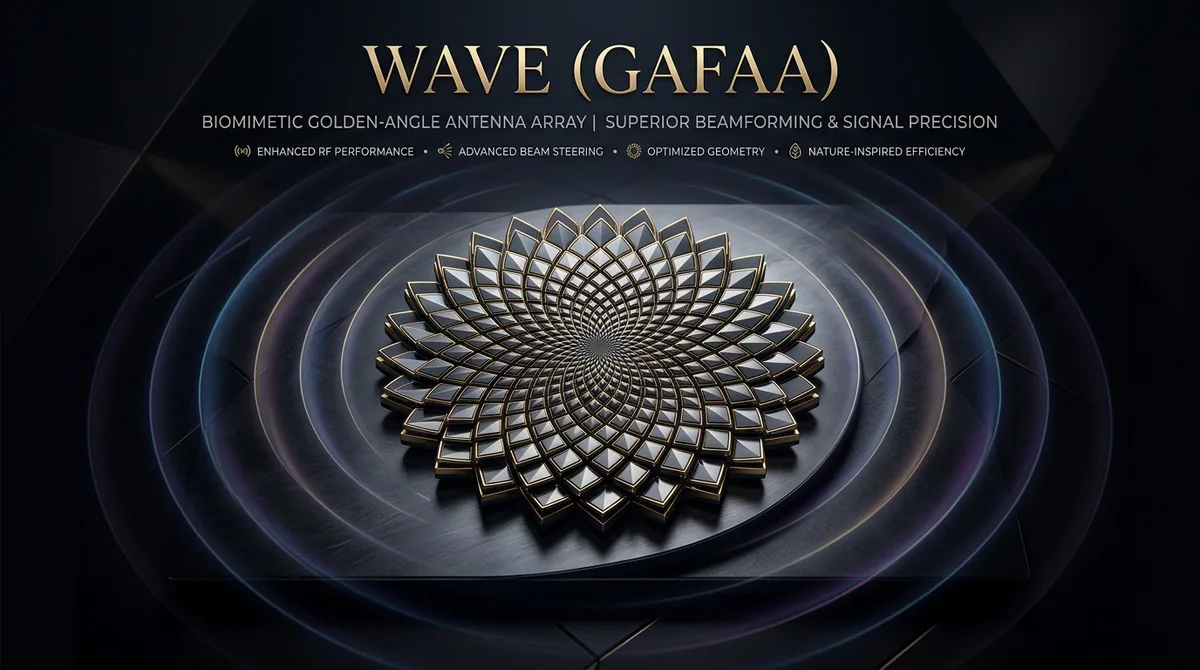
Antenna arrays using 137.508° phyllotactic spacing. Design intent: aperiodic layout, signal integrity in dense spectrum, scalable curved and planar surfaces. Public claims stay at layout and simulation until measured patterns ship.
Frequency band (goal)1–100 GHz
Elements (goal)121 node and related counts
Mutual coupling (goal)<-20 dB — unverified on site
Beamforming (goal)Wide azimuth and elevation targets
Use cases (illustrative)Satcom, cellular, radar, deep space
Neural electrode layout using golden angle placement. This is geometry and materials research, not a cleared clinical device on this site. Any coverage or density multiples need peer literature or trial data before they count as product claims.
Coverage (design sketch)High coverage goal — not clinically validated here
PhiKey names geometric and constant aware key material ideas. We do not claim a finished, audited post quantum product on this page. Standard cryptography still carries the burden of proof; we publish direction and hooks, then let review say what is safe at scale.
Key storyLayout tied derivation concepts, partner docs where released
Security reviewNot represented as complete third party audit
Post quantumUnder evaluation; no shipping guarantee
Use cases (illustrative)High assurance storage, finance, IoT partners
StatusDesign and lab code; production cryptosystem TBD with counsel
Open phyllux-core exposes constants and integrity helpers for engineering demos. That is not the same as a certified vault SKU.
Partners who need depth should book a call. We will not oversell audit status.
Unified coordinate story across WAVE, MESH, VAULT. Targets cross domain timing and phase discipline. Extreme timing claims wait on hardware program milestones.
All pillars share the same positioning formula: r = k × √n, θ = n × 137.508°. Position 61 is the design reference anchor. Scale ranges are design space until measured.