Black box track: This hub is public; core implementation and repo detail stay partner scoped. Research status (what ships, what is spec): Research status. Technical briefings under NDA: Partners.

Science

Inquiry, Evidence, Wonder

Science is not a religion—it makes no claims about the sacred—but it is a profound human path. Observation, hypothesis, experiment, revision. The universe reveals itself through evidence. Science cultivates wonder before the vast, humility before the unknown, and a shared commitment to truth that transcends any single tradition. It belongs in this conversation because it, too, seeks to understand—and because the best of science and the best of religious traditions share a kinship of spirit.

What We Hold Sacred

Evidence, wonder, and the humility of not knowing

Science holds sacred what can be tested—evidence, reproducibility, the willingness to be wrong. It does not claim revelation from a divine source, yet it has its own transcendent secret: the universe is knowable. The same laws that govern the fall of an apple govern the orbit of galaxies. Mathematics, which exists in the human mind, describes the structure of reality with uncanny precision. The transcendent secret of science is wonder—Einstein's "most beautiful experience," the mysterious that gives rise to all true art and science. What science holds most sacred is the method: observe, hypothesize, test, revise. Conclusions are provisional; the process is eternal. The scientific community is bound by a covenant of honesty—peer review, citation, the acknowledgment of uncertainty. Science and religion need not conflict; both stand before the vast. Science asks how; religion often asks why. What science holds sacred is the humility of not knowing—and the joy of finding out.


Wonder Before the Cosmos

The starting point of inquiry

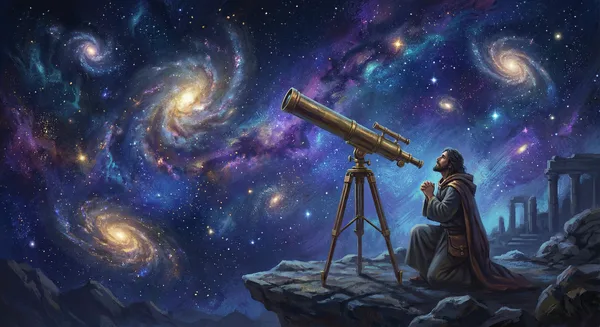
Scientists often speak of wonder—the astonishment at the scale of the universe, the elegance of equations, the complexity of life. Einstein wrote that the most beautiful experience is the mysterious: "It is the source of all true art and science." This wonder is not unlike the awe that religious traditions cultivate. Both ask: Why is there something rather than nothing? Both stand before the vast.

Deep space — galaxies, nebulae, the vast cosmos
Cosmos — image to be generated

The Scientific Method

Observation, hypothesis, experiment, peer review

Science proceeds by observation—careful, repeatable. Hypotheses are proposed, tested, and revised. Experiments must be replicable. Peer review holds researchers accountable. Conclusions are provisional—always open to correction. This discipline is a kind of asceticism: the willingness to be wrong, to update, to follow the evidence wherever it leads.

Laboratory — clean, precise, instruments of measurement
Inquiry — image to be generated

Humility & Epistemic Virtue

Knowing that we do not know

Science teaches humility. The more we learn, the more we confront the unknown. Dark matter, dark energy, the origin of consciousness—vast domains remain mysterious. Good science admits uncertainty. It does not claim final answers. In this, it resembles the apophatic tradition in religion—knowing God by knowing what God is not. Both traditions honor the limits of human understanding.

Human figure small against vast cosmos — perspective, scale
Perspective — image to be generated

Connection to Religious Traditions

Not in opposition—in conversation

Science and religion have often been framed as adversaries. But many scientists are religious; many religious traditions embrace scientific discovery. Conflict between them is not inevitable. Science asks how; religion often asks why. Both can coexist—and many find that the order revealed by science deepens their sense of the sacred. The project of this site is to hold them together: traditions of faith and the tradition of inquiry, each honored, each shining.

See the Connections page for shared themes: compassion (in scientific cooperation), community (the global scientific network), and wonder (before the cosmos).