Connections
How We Are Connected
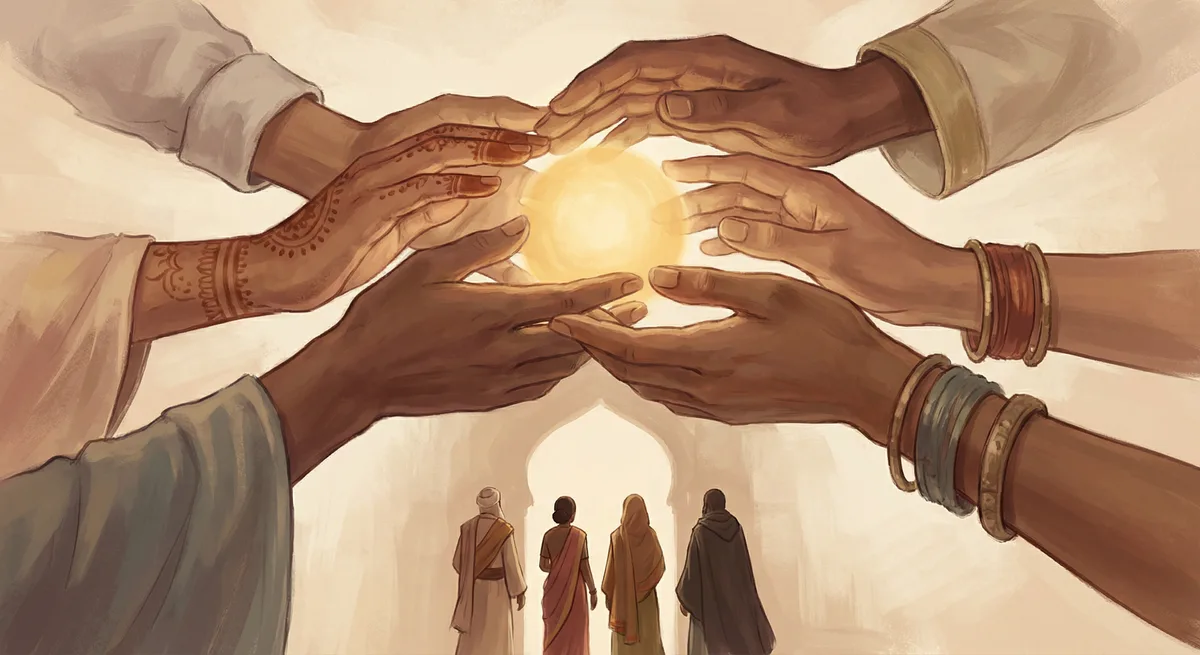
Across Islam, Christianity, Buddhism, Hinduism, Judaism, Sikhism, Taoism, Confucianism, Jainism, Baha'i, Zoroastrianism, Shinto, Yoruba traditions, Vodou, Tengriism, Candomblé, Rastafari, Umbanda, Druze, Cao Dai, Samaritan, Indigenous Americas, Sufism, Manichaeism, Gnostic traditions, Mithraism, and the path of science, certain threads recur. Not to erase difference—each tradition is distinct and precious—but to reveal the shared human longing for meaning, goodness, and connection to something greater.
Compassion & Love
The Golden Rule appears in every tradition.
Islam: "None of you truly believes until he wishes for his brother what he wishes for himself." (Hadith)
Christianity: "Love your neighbor as yourself." (Mark 12:31)
Buddhism: Karuṇā—compassion for all beings—sits at the heart of the bodhisattva path.
Hinduism: "This is the sum of duty: do not do to others what would cause pain if done to you." (Mahabharata)
Judaism: "What is hateful to you, do not do to your neighbor." (Hillel, Talmud)
Sikhism: Seva—selfless service—and langar, where all eat as equals.
Confucianism: Ren—benevolence, humanity. "Do not impose on others what you yourself do not desire."
Jainism: Ahimsa—non-violence toward all beings, extending compassion even to the smallest life.
Zoroastrianism: Good thought, good words, good deeds—the triad of righteousness.
Yoruba: Reverence for ancestors, community (egbe), and the ethic of right relationship with the Orisha.
Vodou: Sèvis—service to the lwa and to community—reciprocity, healing, solidarity.
Candomblé: Devotion to the orixás—feeding, dancing, community—axé as life force.
Rastafari: One Love—the recognition that we are all one under Jah, bound to uplift each other.
Umbanda: Caridade—charity without charge, service to the suffering, the poor, and spirits in need.
Druze: Mutual aid, truthfulness, loyalty—the ethic of the Muwahhidun.
Cao Dai: Explicit unity of religions—Buddha, Lao Tzu, Confucius, Jesus, Muhammad as teachers of one truth.
Samaritan: The Torah as covenant—commandments, community, and the sacred mountain. Same ancient root as Judaism.
Indigenous Americas: Reciprocity, relationship with land, gratitude—the ethic of balance and giving back.
Sufism: Ishq—divine love. "The lover's religion is distinct from all others; for Sufis, the religion and creed is God."
Science, too, depends on cooperation, peer review, and the humility to be corrected—a kind of epistemic compassion.
Sacred Text & Revelation
Each tradition holds a living text at its center.
The Qur'an, the Bible, the Tripitaka, the Vedas and Upanishads, the Torah and Talmud—each tradition has sacred words that are recited, studied, and lived. Manichaeism (historical) produced elaborate texts—the Living Gospel, the Treasure of Life—in many languages; most are lost, but fragments survive. Gnostic traditions (historical) left texts such as the Gospel of Thomas and the Apocryphon of John, recovered in the Nag Hammadi library. Mithraism (historical) left no scriptures—its teachings were transmitted orally in initiation—but its iconography (tauroctony, grades) survives in archaeology. These texts shape identity, ritual, and ethics. They are not merely historical documents but living presence: heard in prayer, chanted in worship, memorized by the young.
Science has its "texts" too—peer-reviewed papers, textbooks, equations—provisional and revisable, but no less formative of a shared way of knowing.

Pilgrimage, Prayer & Practice
The body and the journey matter.
Hajj to Mecca, pilgrimage to Jerusalem or Santiago, circumambulation at Bodh Gaya, bathing in the Ganges—each tradition marks sacred geography. Prayer, meditation, fasting, ritual—these practices orient the soul. Mithraism (historical) had initiation in the mithraeum; Gnostic and Manichaean rites enacted ascent. They are not escapist; they return the practitioner to the world with renewed purpose.
Science has its practices too: the laboratory, the telescope, the field study. Reproducibility, observation, measurement—rituals of a different kind, but no less disciplined.

Community & Covenant
We are not saved or awakened alone.
The ummah, the Church, the sangha, the caste and village, the Jewish people—each tradition understands itself as a people, a community bound by shared story and obligation. Manichaeism (historical) had Elect and Hearers; Mithraism (historical) bound initiates in the mithraeum; Gnostic traditions (historical) gathered around shared gnosis. Salvation, liberation, or flourishing is never merely individual. We carry each other.
The scientific community, too, is a global network of peers who build on each other's work, cite each other, and correct each other—a covenant of evidence and honesty.

Transcendence & Wonder
Beyond the self, toward something greater.
Whether it is union with the Divine, liberation from suffering, or the dissolution of the ego—every tradition points beyond the narrow self. Gnostic traditions (historical) sought ascent through gnosis; Manichaeism (historical) the liberation of light; Mithraism (historical) a soul-journey through seven grades toward the stars. Wonder before the cosmos, awe before the sacred, the recognition that we are small and yet somehow part of something vast.
Science, at its best, cultivates the same wonder: the humility of not knowing, the joy of discovery, the sense that the universe is stranger and more beautiful than we imagined.